
Bird of Paradise Growing Guide
What is Bird of Paradise?
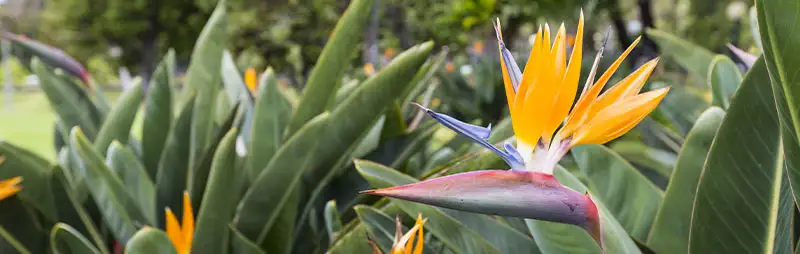
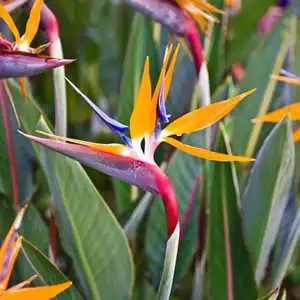
Bird of Paradise (Strelitzia reginae) also known as Strelitzia, Crane Flower, Bird’s Tongue Flower is a herbaceous perennial. It is part of the Strelitziaceae family and is native to South Africa. Bird of Paradise forms an upright habit with large paddle shaped foliage that comes in the colour of green to blue grey. In Spring to Summer the iconic Bird of Paradise flower will appear with brilliant orange and deep purple flowers that resemble the head of a tropical bird. The flower is held aloft on the tall long leafless stems. The Bird of Paradise will take up to 4 to 5 years to mature before it will first flower. It also needs other conditions met such as enough sun, free draining soil and the right amount of water. They require at least 6 hours of sun per day and is important that they are planted in well draining soil. They are a drought tolerant plant once established but require protection from heavy frost and strong wind. There are other varieties of Bird of Paradise such as Strelitzia nicolai which is the giant Bird of Paradise, growing up to 10m in height. It also has a white flower instead of the orange.
Benefits of Growing Bird of Paradise
Bird of Paradise are tough hardy plants. They are perfect for beginner gardeners as they don’t ask very much once established. They’ll withstand drought, salty coastal conditions, light frost and general neglect. They look great planted in a tropical style garden settings, poolside, grassy borders or as a feature plant. Bird of Paradise are also ideal for pots and containers, and the exotic flowers are long lasting and look great in floral arrangements.
How to Grow Bird of Paradise
Climatic Zones
Cool to tropical.
Plant Size
Height: 1.2m, Width: 90cm
When To Plant Bird of Paradise
Plant anytime.
Soil Preparation
They require moist well drained soil that is enriched with organic matter. Mix through well broken down animal manure or compost before planting. Soil must be free draining otherwise the roots can rot if sitting in boggy soil.
How To Plant Bird of Paradise
Plant in full sun but can grow in part shade, with the plant crown at soil level.
Bird of Paradise Plant Care
Regular watering to keep the soil moist during Spring and Summer during warm weather and the growing period. If planted in a pot water when the surface of the soil feels dry.
Mulch to retain moisture.
Although not essential, an annual applications of a controlled-release fertiliser will improve performance.
Removing dead or damaged leaves and flower stalks once they have finished.
Root rot is a problem if the soil is not free draining.
Mealy Bug or Scale can also be a problem.
Strelitzia Varieties: Which Bird of Paradise Should You Grow?
There are two Bird of Paradise varieties commonly grown in Australian gardens, and they suit quite different spaces.
Strelitzia reginae is the classic Bird of Paradise — a compact plant growing to around 1.2 metres tall, producing the iconic orange and blue flowers that resemble a tropical bird in flight. It’s ideal for garden beds, borders, pots and courtyards, and flowers prolifically once established.
Strelitzia nicolai, known as the White Bird of Paradise or Giant Bird of Paradise, is a dramatically larger plant that can reach 6–10 metres in ideal conditions. It produces white and blue flowers and is prized more for its enormous, paddle-shaped leaves than its blooms. It makes a stunning architectural statement in larger gardens or as an indoor specimen in a bright room.
For most home gardeners, Strelitzia reginae is the more practical choice. Strelitzia nicolai suits those after a bold, tropical focal point with plenty of space to accommodate it.
Garden Express stocks Bird of Paradise plants ready for planting in your garden or pot.
Growing Bird of Paradise Indoors
Strelitzia nicolai in particular has become a popular indoor plant thanks to its dramatic foliage. To grow Bird of Paradise successfully indoors:
- Choose the brightest spot available — ideally a north or east-facing window with several hours of direct sunlight daily
- Use a large pot with excellent drainage and a premium potting mix
- Water when the top few centimetres of soil feel dry, and reduce watering in winter
- Wipe leaves occasionally with a damp cloth to remove dust and help the plant photosynthesise
- Don’t expect flowers indoors — Bird of Paradise rarely blooms inside without very strong, direct light
- Repot every two to three years as the plant becomes root-bound
Note that Strelitzia reginae can also be grown indoors in a very bright position, but it is much more likely to flower if grown outdoors.
Why Won’t My Bird of Paradise Flower?
This is one of the most common questions about Bird of Paradise, and the answer is almost always one of the following:
The plant is too young. Bird of Paradise can take anywhere from three to five years to produce its first flowers, even in ideal conditions. Patience is essential.
Not enough sunlight. Bird of Paradise needs at least six hours of direct sun per day to flower reliably. Plants grown in too much shade will produce lush foliage but few or no blooms.
The roots are not established. Somewhat counterintuitively, Bird of Paradise flowers more reliably when slightly root-bound. Avoid repotting into an oversized container, and don’t be too quick to divide the plant.
Inconsistent watering or feeding. Ensure the plant receives regular water during the growing season and an application of slow-release fertiliser in spring to support flowering.
Cold damage. Prolonged frost or cold snaps can set the plant back and delay flowering. In cooler regions, protect plants with frost cloth over winter.
Pruning Bird of Paradise
Bird of Paradise requires minimal pruning. Remove spent flower stalks at the base once flowering has finished, and cut away any dead, damaged or yellowing leaves at the base of the plant using clean, sharp secateurs.
Avoid cutting back healthy green leaves unnecessarily — the foliage is what photosynthesises and feeds the plant, and removing too much can stress it and delay flowering.
For Strelitzia nicolai, older lower leaves will naturally die off as the plant matures, giving it a palm-like trunk. Simply remove these as they brown off.
Propagating Bird of Paradise
Bird of Paradise can be propagated in two ways: by seed or by division.
Propagation by division is the more reliable method for home gardeners. In spring, carefully dig up an established clump and use a sharp spade or knife to separate the rhizomes, ensuring each division has several healthy shoots and a good root system. Replant divisions at the same depth as the original plant and water in well. Note that divisions can take a year or two to settle in before flowering resumes.
Propagation by seed is possible but slow — germination can take one to three months, and plants grown from seed may take five or more years to flower for the first time.



