Hover
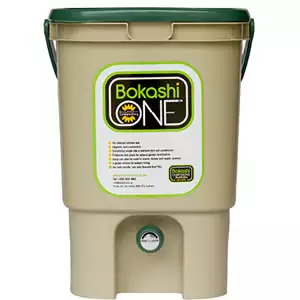
Bokashi Bucket – Beige W/ 1kg Powder
Each
The Bokashi One™ Bucket reduces the need for an outside compost pile and is easier to maintain than a worm farm. The airtight lid ensures an ideal environment for anaerobic fermentation to take place, while controlling odours and deterring flies. Placing the plastic grate inside the bucket and then piling food waste on top of it separates the food waste from the liquid that accumulates at the bottom of the bucket. This liquid can be easily drained through the tap and used as a nutrient-rich fertiliser for the garden.
This Beige Bucket is 410mm high, 310mm wide and 300mm deep, stores neatly under kitchen sink. The Bokashi Bucket can hold approximately 19 litres of food waste. It is supplied with a 1kg (approximately 4L) bag of Bokashi Powder
It’s practical, simple and easy to use:
- Composts all kitchen waste hygienically minus the unpleasant odours and insects
- Waste is conveniently stored indoors – no need to run outside to the compost bin
- Keeps your kitchen bin fresher for longer as food waste is stored in your airtight Bokashi One™ Bucket
- Conventional composting can be a long, complicated and involved process, taking up to a year to complete. Bokashi composting, on the other hand, is rapid, occurring in a matter of weeks.
Download Instructions PDF (3.2MB)
Orders containing up to 3 items of the same size will increase the freight charge to $16.90. Orders containing 4 or more items of the same size will incur a larger freight fee; this will be calculated at the checkout.
Important Reminder: While we take great care in the realistic representation of our products, many variables such as climatic conditions, natural variation or manufacturing changes may affect the precise appearance of each variety. Generally, images used are of mature specimens whilst supplied stock may be dormant or juvenile plants that will develop with time. The images are intended as a guide only.
Availability: OUT OF STOCK/OUT OF SEASON! Available to order all year, unless sold out.
Original price was: $99.00.$89.00Current price is: $89.00.
Multibuy Prices
Buy 2 or more of this item and get them for $79.50 per item
*Price adjustments will be reflected in the cart.
Out of stock
Send me an email when this item is back in stock.
Money-Back Guarantee
 GUARANTEE & RETURNS:At Garden Express, we want to ensure that you have a positive purchasing experience. On the off chance your plants get stuck in the mail or haven’t arrived in the best condition, we ask that you reach out to us promptly with any concerns or issues. You can contact us via email at info@gardenexpress.com.au or by phone at 1300 606 242, Monday to Friday 8:30 AM – 5:00 PM Australian EST, contacting us through social media platforms may be less reliable, so we encourage you to use our email.Please note that it’s important to get in touch with our customer service team within 7 days of receiving your order if you have any concerns as claims regarding arrival condition after 7 days of arrival will not be recognised.Please also remember not to dispose of any items until you’ve spoken to us, as to be eligible for a replacement, credit, or refund, we may request photos or additional information for any item(s) in question.If you need to make a return, please contact our Customer Service department via email at info@gardenexpress.com.au or by phone at 1300 606 242 for authorisation before proceeding. Once again contacting us through social media platforms may be less reliable, so we encourage you to use our email or phone number for a smoother experience.It is also important to mention that discounted ‘end-of-season’ stock is sold on an ‘as is’ basis and is exempt from this guarantee. While this stock is generally sound, we recommend planting these items as soon as possible.
Our team packs and dispatches each day based on the best timing of delivery service to your state. This way we can ensure your order is in transit for the shortest time possible.
Delivery is normally via Australia Post with larger orders delivered via StarTrack Express* courier. We service virtually all areas of Australia with only those areas not serviced by these organisations being excluded (e.g. remote islands and Territories such as Christmas Island, Lord Howe Island, Norfolk Island, Cocos Islands, Groote Eylandt). We do not deliver outside Australia but happily deliver orders placed from overseas for Australian delivery. Our regular delivery charge for basic items is $12.50 Australia-wide, regardless of the number of items ordered. Due to their higher freight costs, bulky or heavy products such as roses, large pots and a small number of hard goods have higher delivery charges. The summary of all current delivery options is:
- Basic Postage $12.50: Applies to orders NOT containing Roses, 120mm and larger pots/grow-bags, Bare-rooted Trees, Composting Buckets, nor any items with individually specified delivery charges, all delivered at one time, will incur the normal $12.50 freight charge. These items are referred to as “Basic Items“.
- Roses & Larger Potted Items $16.90: Applies to orders containing bush Roses, 120mm up to 155mm pot/grow-bags, Composting Buckets, together with other products delivered at the same time will incur a $16.90 freight charge. **Please Note: Multiples of these items may incur a larger freight fee depending on the quantity of pots in the order; this will be calculated at the checkout.
- Small Trees & Large Pots $25.50: Applies to orders containing Trixie Fruit Trees, Dwarf Fruit Trees, Lilac Trees, Standard and/or Patio Roses, 160mm up to a 200mm pot/grow-bags, together with other products delivered at the same time will incur a $25.50 freight charge. **Please Note: Multiples of these items may incur a larger freight fee depending on the quantity of pots in the order; this will be calculated at the checkout.
- Trees up to 1m $35.00: Applies to orders containing smaller bare-rooted trees up to 1m in height. Larger items or pots/grow-bags greater than 200mm, together with other products delivered at the same time, will incur a $35.00 freight charge. Remote areas may incur an additional Freight charge but we will notify customers individually if this is the case. **Please Note: Multiples of these items may incur a larger freight fee depending on the sizes and quantity of items in the order; this will be calculated at the checkout.
- Trees 1m up to 1.49m $50.00: Applies to orders containing bare-rooted trees between 1 to 1.49m in height. Bare Rooted trees 1m to 1.5m in height, together with other products delivered at the same time, will incur a $50.00 freight charge. Remote areas may incur an additional Freight charge but we will notify customers individually if this is the case. **Please Note: Multiples of these items may incur a larger freight fee depending on the sizes and quantity of items in the order; this will be calculated at the checkout.
- Trees 1.5m up to 2m $85.00: Applies to orders containing bare-rooted trees between 1.5 to 2m in height. Bare Rooted trees 1.5m to 2m in height, together with other products delivered at the same time, will incur a $85.00 charge. This consists of $65.00 Freight Fee and $20 Oversize Surcharge, as charged by the Courier. Remote areas may incur an additional Freight charge but we will notify customers individually if this is the case. **Please Note: Multiples of these items may incur a larger freight fee depending on the sizes and quantity of items in the order; this will be calculated at the checkout.
- Trees 2m up to 3m $135.00: Applies to orders containing bare-rooted trees between 2 to 3m in height. Bare Rooted trees 2m to 3m in height, together with other products delivered at the same time, will incur a $135.00 charge. This consists of $95.00 Freight Fee and $40 Oversize Surcharge, as charged by the Courier. Remote areas may incur an additional Freight charge but we will notify customers individually if this is the case. **Please Note: Multiples of these items may incur a larger freight fee depending on the sizes and quantity of items in the order; this will be calculated at the checkout.
- Orders containing products with explicitly stated delivery charges will incur charges as detailed in the individual product description.
- Express Post: If you require your order to be sent Express Post, please call our office and we will arrange a quote. Please Note: Quarantine orders cannot be sent using Express Post; our experience is that it will actually delay your order due to the inspection process required for entry into these states.
- Order Split Fee: Some items may be delayed due to climatic or growing habits prevent them from being harvested at the time of being offered for purchase. You will be offered a choice to wait until all items on your order are available or to receive what is currently available for an additional freight charge of $5.00.
- We continue to maintain the simplest form of postage costs for the large variety of products we range, however in occasional circumstances of oversized orders and/or delivery location, the cost of freight can significantly impact delivery of an order therefore we reserve the right to refuse the order or contact the customer to discuss freight options and pricing.
Orders containing products from two different seasons (eg Rose or spring bulb pre-orders) that require separate deliveries will incur two delivery charges at the relevant rates (unless a free freight offer applies). A $5.00 Quarantine Inspection Surcharge applies in addition to the Delivery Charge for orders delivered to Tasmania, Northern Territory and Western Australia due to the increased complexity of quarantine requirements.
As quarantine inspections apply to each delivery, 2 quarantine charges will apply where orders contain products from different seasons. *Please note that if you order large items (eg Patio, Standard or Weeping Roses, Fruit Trees) you must specify a street address for the delivery address. StarTrack Express generally do not deliver to PO Boxes or RSD addresses so your order will be held until a suitable address is obtained. In rural areas, StarTrack may deliver to physical addresses such as general stores that act as Australia Post agencies but we suggest you check with them first. Where ”Free Delivery” vouchers apply to an order, details of the voucher should be entered in the “Your message to us” field. Orders (except Pre-orders) are normally despatched within 7-14 working days from the time of ordering during busy periods. Delivery times may be extended during peak periods (typically following the release of the latest catalogue), extended public holidays, if extreme weather conditions are not suitable for live plant transport or as detailed in the product description.
Individual items may be back-ordered to avoid delaying the delivery of other items. Please allow additional delivery time for orders to Tasmania, Northern Territory and Western Australia due to quarantine restrictions.
Please note: Some orders may not be possible to parts of Australia due to quarantine and some items may carry unique delivery charges. Check full delivery policy.
Looks great in the garden with...

Where Roses Can Grow
-

Roses in Pots
Planting roses in pots is an elegant way to appreciate the beautiful blooms in a limited space.
READ MORE -
Ground Cover Roses
Ground cover roses are known for their attractive appearance, flowers and fragrance.
READ MORE -
Climbing Roses
Climbing roses aren’t typically difficult to grow and can transform a garden into something absolutely stunning.
READ MORE -
Patio Roses
When grown right, patio roses can become the most impressive feature in your garden!
READ MORE